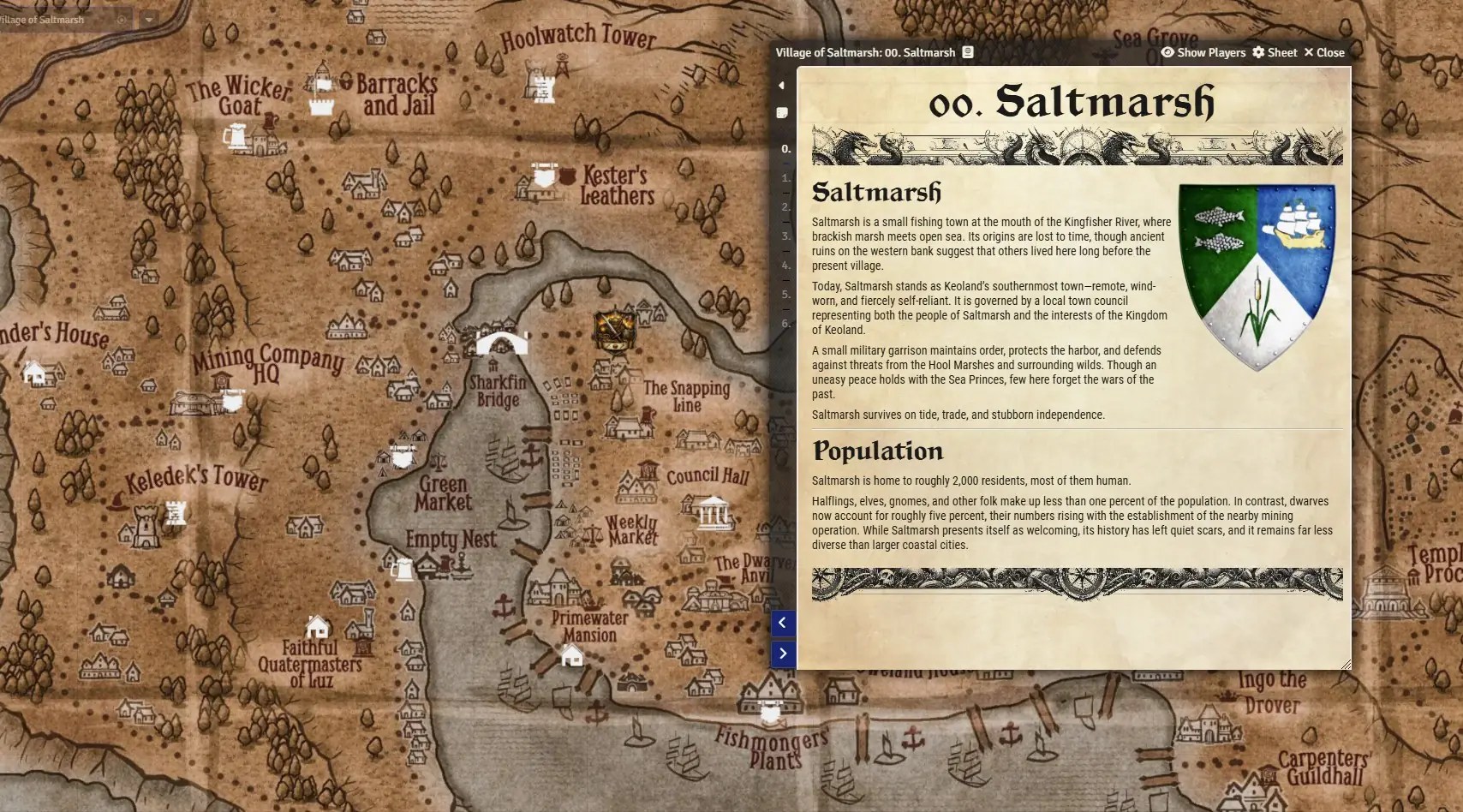

Why Saltmarsh Might Be the Perfect Village for Your Next Campaign
There are countless villages, towns, and cities scattered across the worlds of tabletop RPGs.
Some are too small.
Some are too large.
It reminds me a bit of the old story of Goldilocks and the Three Bears.
One bowl of porridge is too hot.
One is too cold.
And one is just right.
For many campaigns, the same problem exists with settlements. A tiny hamlet doesn’t provide enough opportunity. A sprawling metropolis demands so much preparation that the game can lose focus.
But Saltmarsh?
Saltmarsh sits comfortably in the middle.
It’s just right.
Nostalgia, Focus, and the Power of a Small Town
There were several reasons I chose Legends of Saltmarsh as my next project, but if I’m honest, nostalgia was the spark.
Back in the 1980s I played The Sinister Secret of Saltmarsh and Danger at Dunwater. My characters (there were more than one, as it was a more deadlier time) wandered the coastlines and marshes along the edge of Greyhawk without realizing how deeply those early adventures had an influence on me decades latter and fostered amazing memories.
Much like returning to Ravenloft inspired Legends of Barovia, Saltmarsh felt like unfinished business. A place from my childhood waiting to be explored again with fresh eyes.
But nostalgia alone isn’t enough to build a project around.
Saltmarsh offers something more valuable to both players and Dungeon Masters.
It offers focus. I was looking for a hub for my players to begin their adventures, a place familiar to them, a place to return to.
The Weight of Greyhawk
Before Saltmarsh, there was Greyhawk.
Created by Gary Gygax and Dave Arneson in the 1970s and first published in 1980, Greyhawk is one of the oldest fantasy campaign settings in tabletop history. Dozens of classic modules are set here, and entire campaigns were born in its lands.
Add to that the passionate Greyhawk community, the grognards who have carried the setting forward for decades and you have a vast treasure trove of lore.
But there’s also a challenge.
Greyhawk is enormous.
Trying to absorb the entire setting can feel overwhelming.
So Legends of Saltmarsh takes a different approach.
A Focused Slice of the World
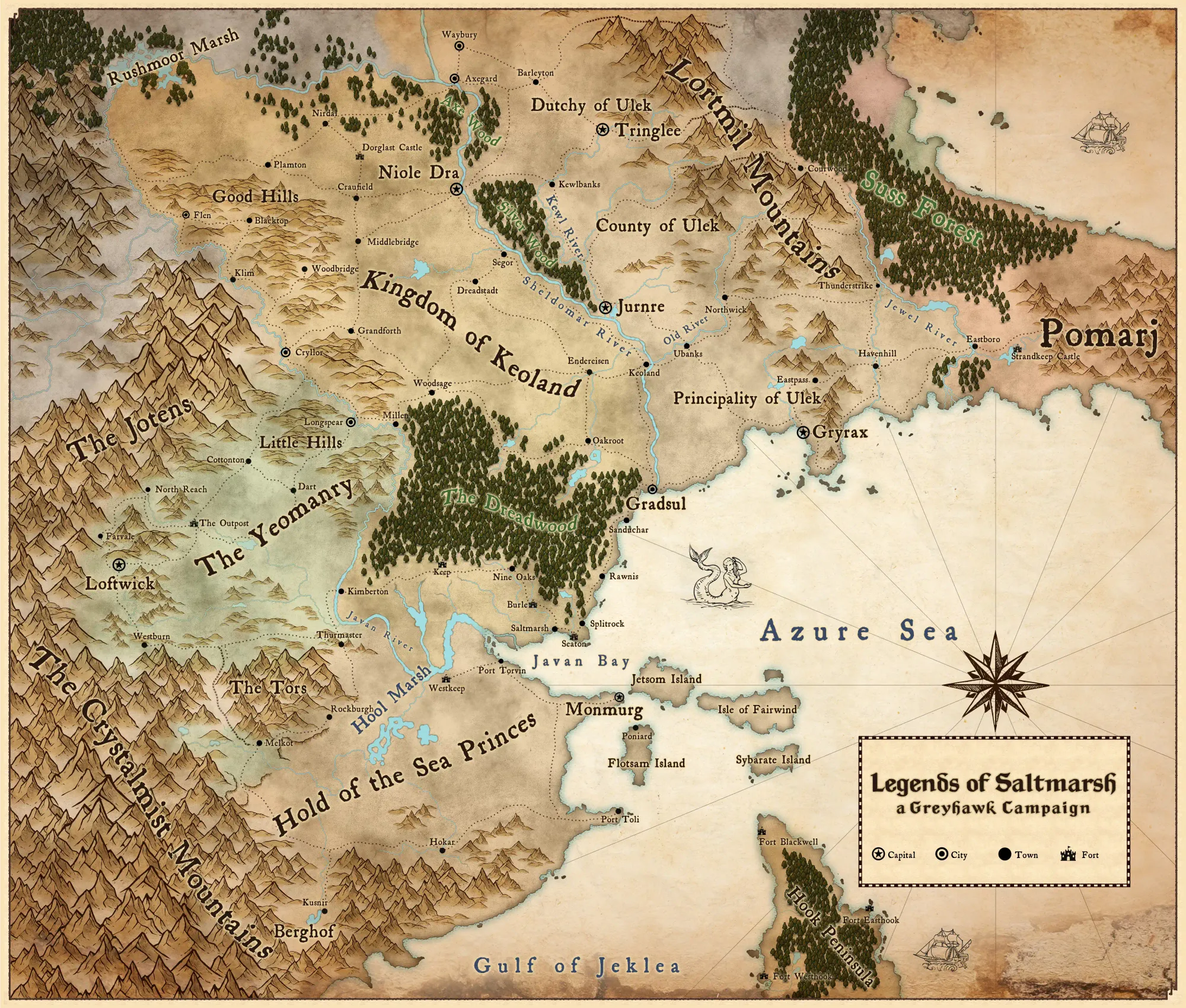
Rather than tackling the entire Flanaess (the greater world of Greyhawk), the project focuses on a single region: the Sheldomar Valley, anchored by the Kingdom of Keoland.
The valley is naturally contained, bordered by mountain ranges and shaped by its own internal history, politics, and rivalries. It provides a rich setting without requiring players or Game Masters to absorb the vast lore of the wider world.
Keoland and its neighbors carry decades of history, including a thirty-year conflict known as Azure’s Tide. During that war, pirates known as the Sea Princes seized the lands south of Keoland, establishing what became the Hold of the Sea Princes. Although a truce has lasted for decades, the tension never truly disappeared, and its echoes are still felt throughout the valley.
Within this setting, Saltmarsh becomes the natural hub.
From this small coastal village you can run the classic Saltmarsh adventures, explore the surrounding wilderness, launch nautical expeditions, run a West Marches–style campaign, draw on the many adventures written for the region, or gradually expand outward into the wider world of Greyhawk.
The region is also rich with classic modules. In addition to the seven adventures from Ghosts of Saltmarsh, nearby locations include the Hool Marsh, home to I2: Tomb of the Lizard King, which I explored in detail in my post The Two Faces of the Hool Marsh Lizardfolk. Another adventure, I7: Baltron’s Beacon, also takes place within the marsh.
Many early Greyhawk adventures can be woven into this region, creating a dense web of locations and story hooks. I’ve even placed The Keep on the Borderlands nearby, expanding the frontier even further. You can read more about how that fits into the region here.
Why Not a Big City?
There’s no doubt big cities are alluring. They capture the imagination. I’ve always been fond of Greyhawk City myself.
But cities are massive in scope. They can easily become overwhelming to run, and players can quickly get lost, especially if the DM doesn’t know the setting inside and out. Mastering that level of lore can feel like studying for a PhD.
These places are incredible settings, but they demand a lot from the Game Master:
Dozens of districts.
Hundreds, sometimes thousands of NPCs.
Layers of faction politics.
And much of it isn’t always tightly woven together. Lore can conflict, timelines can blur, and the sheer scale can become difficult to manage.
For some groups, that complexity becomes overwhelming before the campaign even begins.
Saltmarsh avoids that problem entirely.
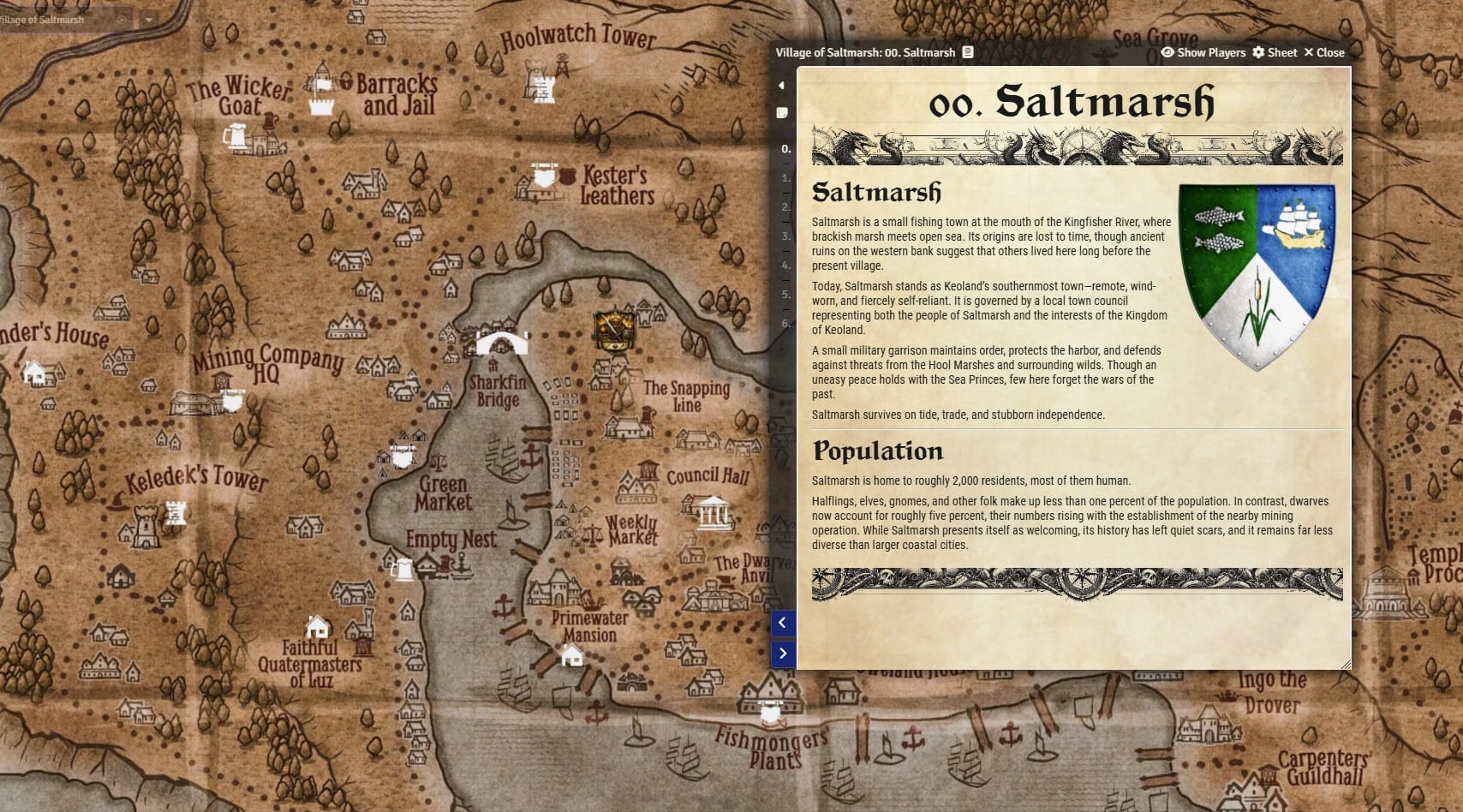
It’s small enough to understand quickly. Not a city, not even a town, just a coastal village.
A few taverns.
A dockside market.
A small garrison.
A council chamber.
A handful of influential families.
Within a single session, players start recognizing faces. Relationships begin to form. The place becomes familiar.
The settlement becomes personal.
It’s large enough to matter, but small enough to manage.
Simple Political Friction
Good adventure hubs need tension.
Saltmarsh provides it immediately through a clear political divide. It’s one of the easiest faction systems in fantasy roleplaying because it reflects something everyone already understands: real-world politics.
Two groups shape the future of the town.
Traditionalists
They want Saltmarsh to remain a small fishing village. They resist outside control and distrust the growing influence of the crown.
Loyalists
They believe the town should grow. Expansion brings trade, military protection, and stronger ties to the Kingdom of Keoland.
At its core, the conflict is simple: preservation versus progress. Local independence versus royal authority.
Because the motivations are clear, a DM can understand the situation quickly, and players can easily decide where their characters stand.
But there is another force quietly working behind the scenes.
A secretive group manipulating events and pushing the conflict further.
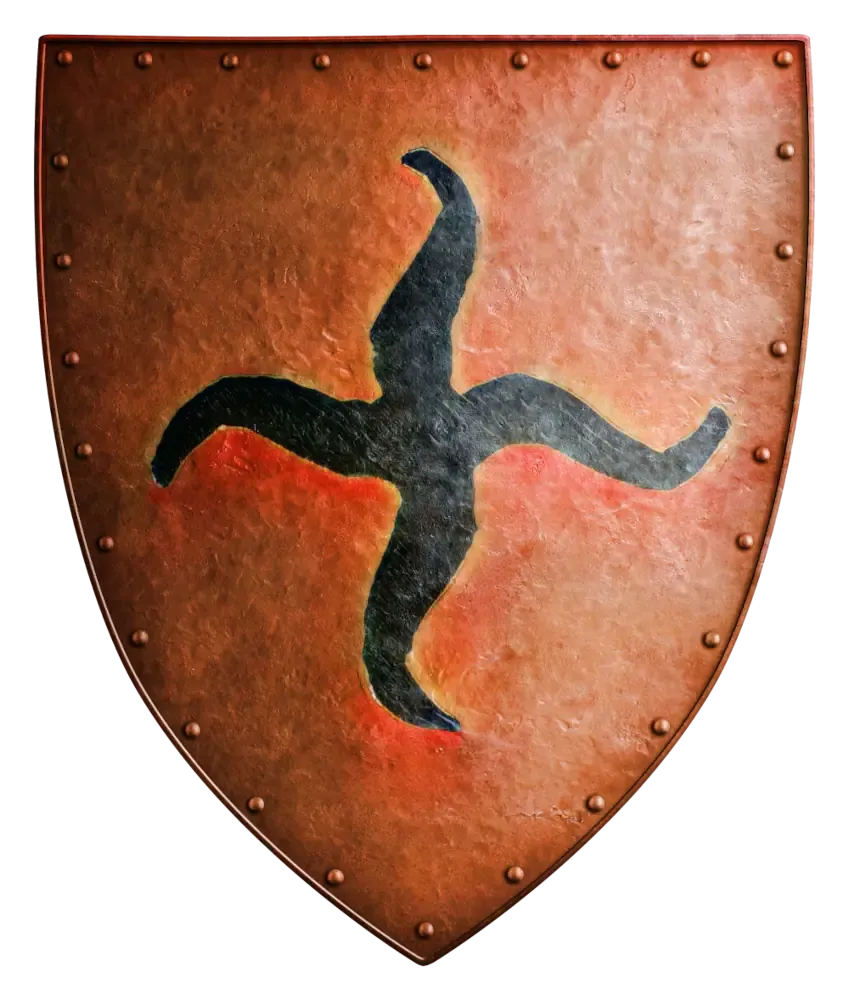
The Scarlet Brotherhood.
A hidden order with long-term ambitions. They can remain whispers in the background or slowly emerge as the true threat behind the turmoil in Saltmarsh.
A Living Underbelly
What’s a port town without a little crime?
Saltmarsh isn’t just politics and fishing boats. Like many coastal villages, it has a darker side.
Smugglers move goods along the coast.
Contraband passes through hidden channels.
Criminal networks use the marshes and isolated coves to avoid the law.
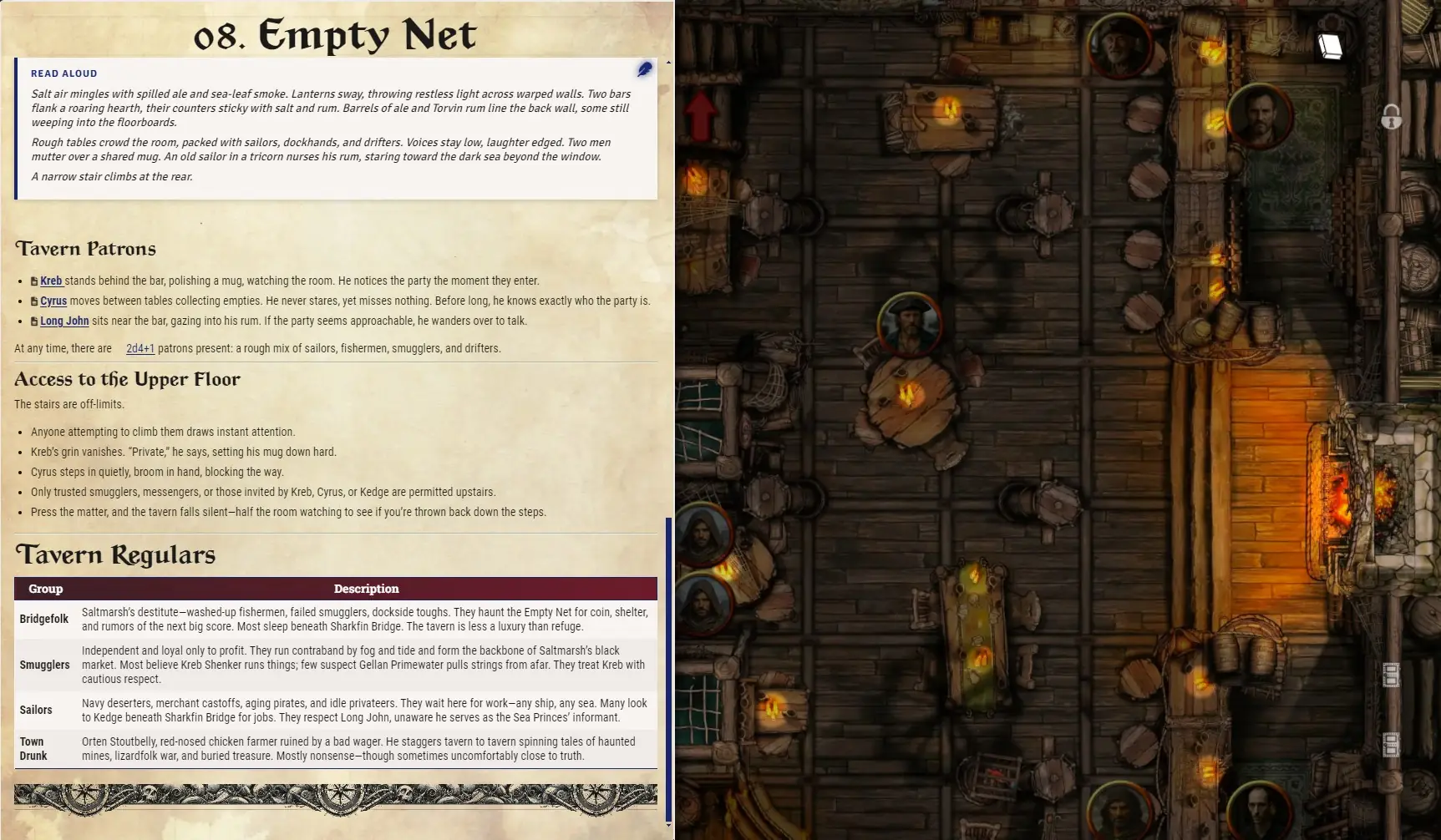
This underbelly naturally creates adventure hooks.
Players might begin by chasing rumors of smuggling, only to uncover something far larger: ancient relics changing hands, whispers of tombs waiting to be plundered, tensions rising between pirates and the crown, or even influential families quietly profiting from illegal trade.
Small crimes can lead to much bigger discoveries.
Saltmarsh’s shadows are home to thieves, assassins, smugglers, and pirates—each with their own schemes and alliances.
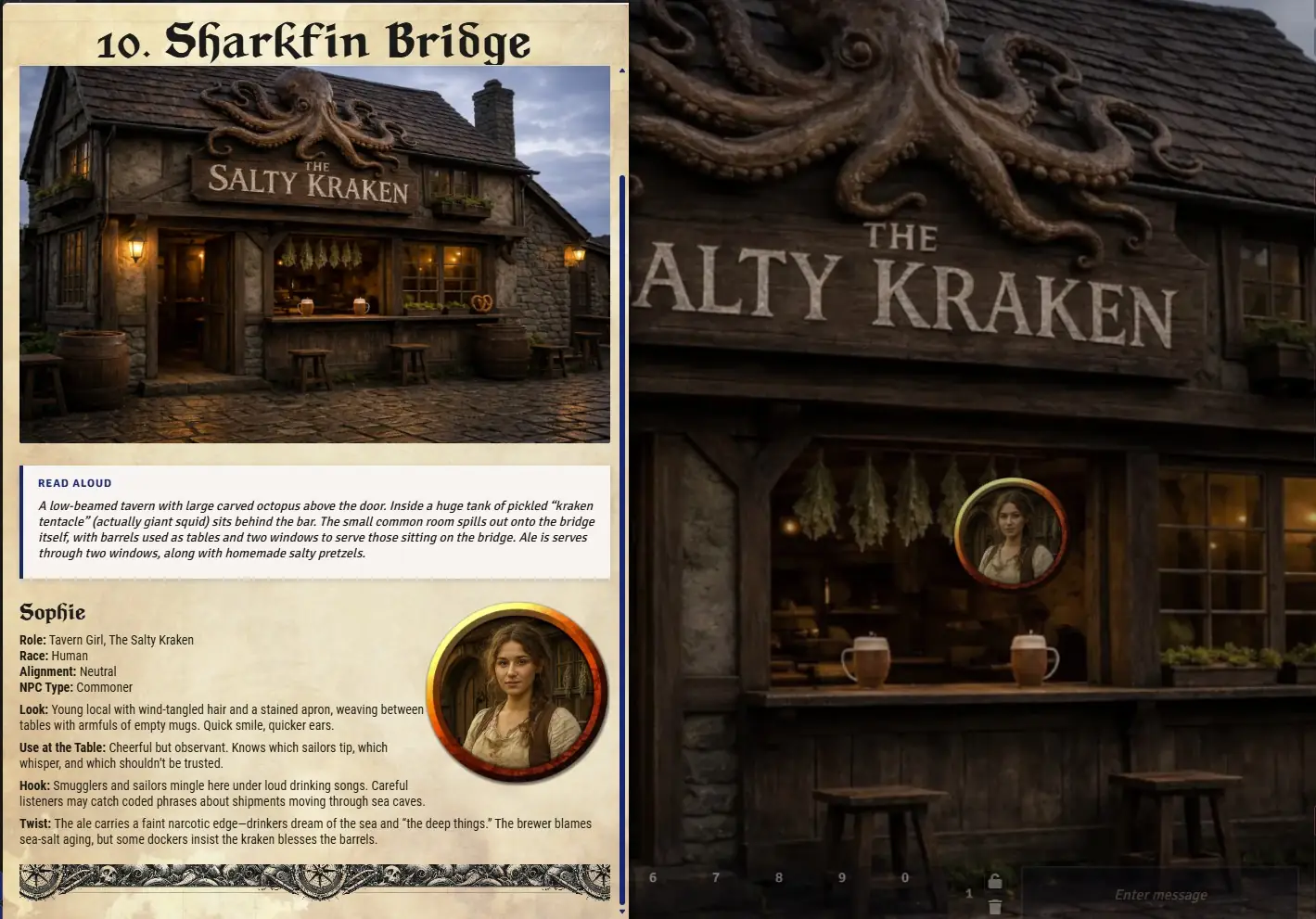
And if you’re looking for where those dealings begin, many of them start at a familiar place along the docks: The Empty Net tavern.
Geography That Encourages Adventure
Another reason Saltmarsh works so well as a campaign hub is its location.
Within a short distance of the village you can find:
- Marshlands filled with strange creatures
- Coastal waters and hidden coves
- Rivers leading inland
- Ancient ruins
- Islands and sea caves
- Forested wilderness
- Abandoned forts and watchtowers
Each direction offers a different style of adventure.
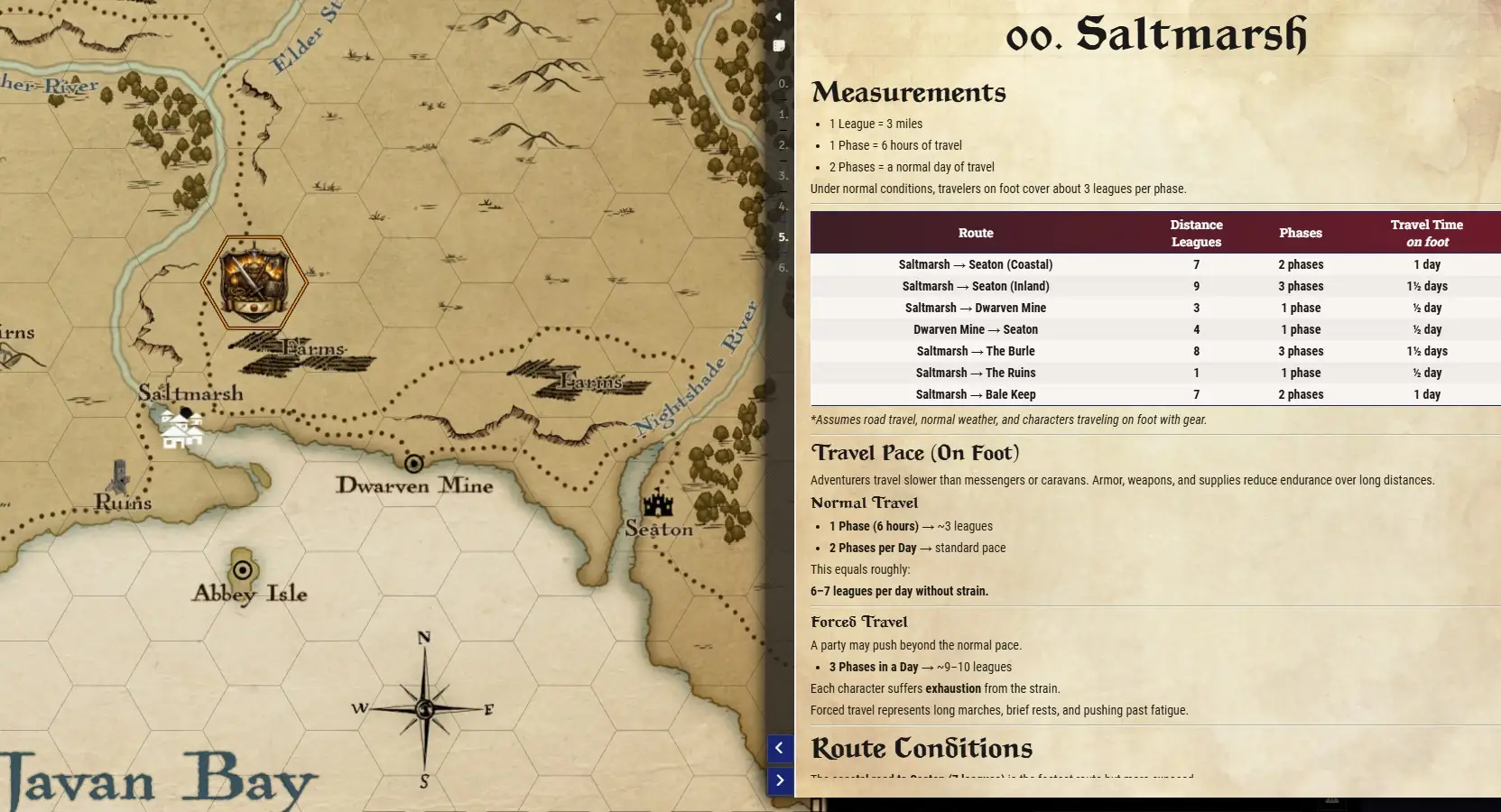
You can run:
- Nautical exploration
- Wilderness survival
- Dungeon delving
- Political intrigue
- Smuggling investigations
Saltmarsh naturally supports one-shots, episodic adventures, long campaigns, or even a West Marches style game where the town acts as a central home base.
Ships leave the harbor.
Rumors spread through taverns.
Expeditions launch into the unknown.
Why a Village Matters to Players
One thing that has always mattered to me as both a DM and a player is having a place the characters can call home.
Too often, adventures begin in a new town or city filled with unfamiliar names, locations, and lore. The party receives a quick information dump, struggles to understand the layout, and just as they begin to get comfortable, the next adventure moves them somewhere else.
The cycle starts all over again.
A familiar home base changes that experience.
When adventurers return to the same place again and again, something interesting happens. The town begins to feel alive.
Players develop allies.
They make rivals.
They learn the rhythms of the place.
The tavern keeper remembers them.
The dockmaster owes them a favor.
The town council might begin to trust or distrust their influence.
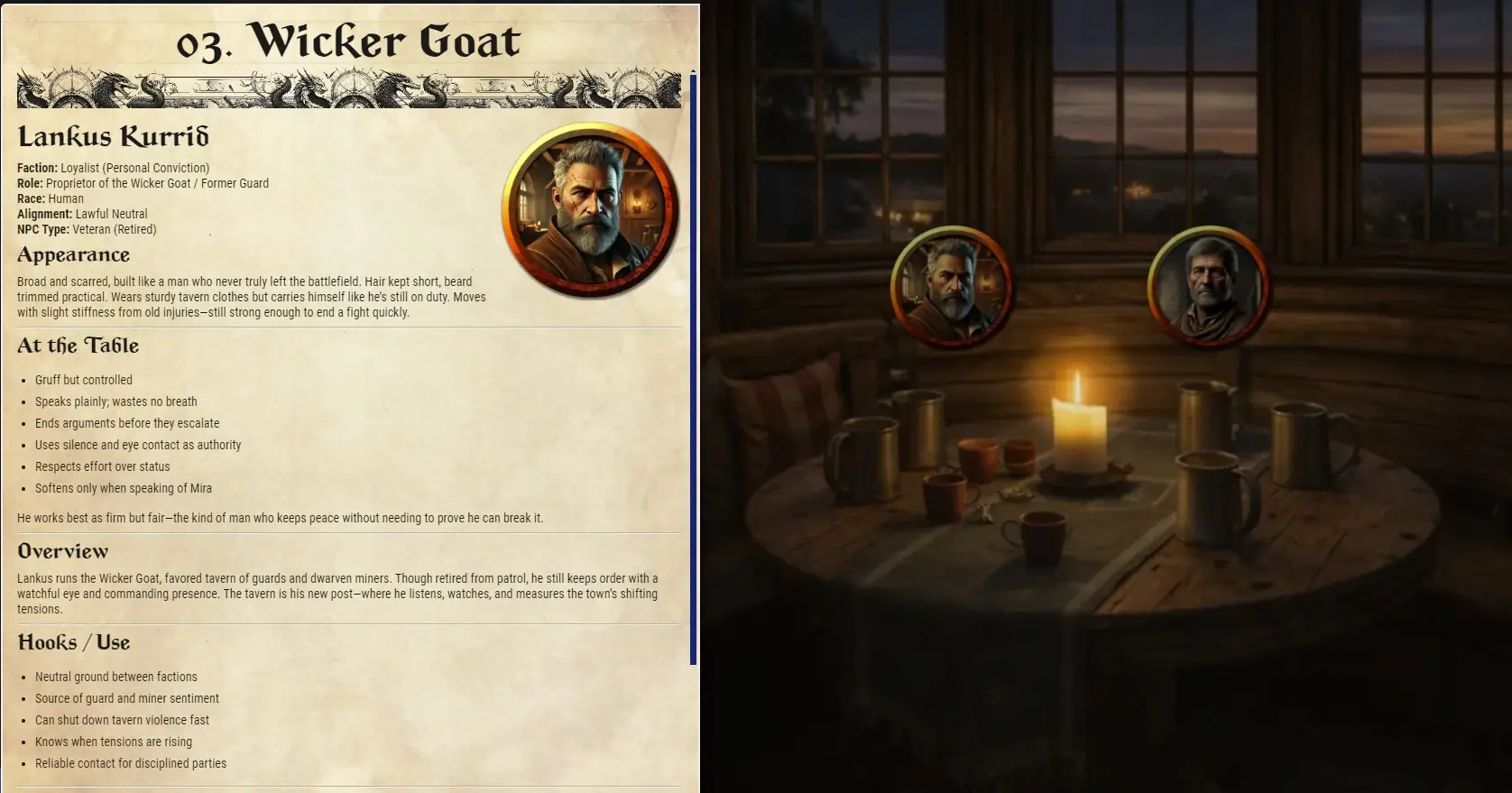
They may align with one faction or another, and their decisions begin to shape the future of the town.
Their actions have consequences.
Over time, the characters stop being visitors.
They become part of the town itself.
Saltmarsh becomes more than a location on a map. It becomes a place to rest, resupply, gather rumors, and watch the ripple effects of their adventures spread through a community they now care about.
In short, it becomes their town.
What Is Legends of Saltmarsh?
At its core, Legends of Saltmarsh is a living campaign setting built around this idea. A centralize hub, a village, for the characters to call home, to become a part of.
The first goal has been to fully flesh out the village itself, set in 576 CY before the Greyhawk Wars. The core setting is based on a combination of the Village of Saltmarsh from Ghosts of Saltmarsh as well as earlier adaptations from the U1-U3 adventures, and Greyhawk Portfolio.
Every location in the town is expanded with:
- deeper lore
- interconnected NPCs
- faction relationships
- secrets
- adventure hooks
The goal is simple:
Make Saltmarsh feel alive.
Events in one part of town should ripple across the rest of the village. A smuggling dispute might strain the council. A missing fisherman could reveal cult activity. Political maneuvering might destabilize trade.
Nothing exists in isolation.
Adventures In and Around Saltmarsh
This project is more than a town guide.
It’s designed to be easy to plug into existing adventures while also expanding the region with new ones.
At its core are the seven classic adventures from Ghosts of Saltmarsh, which fit naturally into the setting. But the surrounding region also includes other nearby modules, such as Tomb of the Lizard King, along with many additional adventures written during the early Greyhawk era. In one of my videos, I explore dozens of adventures that can easily be woven into this area.
Intro to Adventures in the Region
Beyond the classics, I’m also creating new adventures built directly from the village itself.
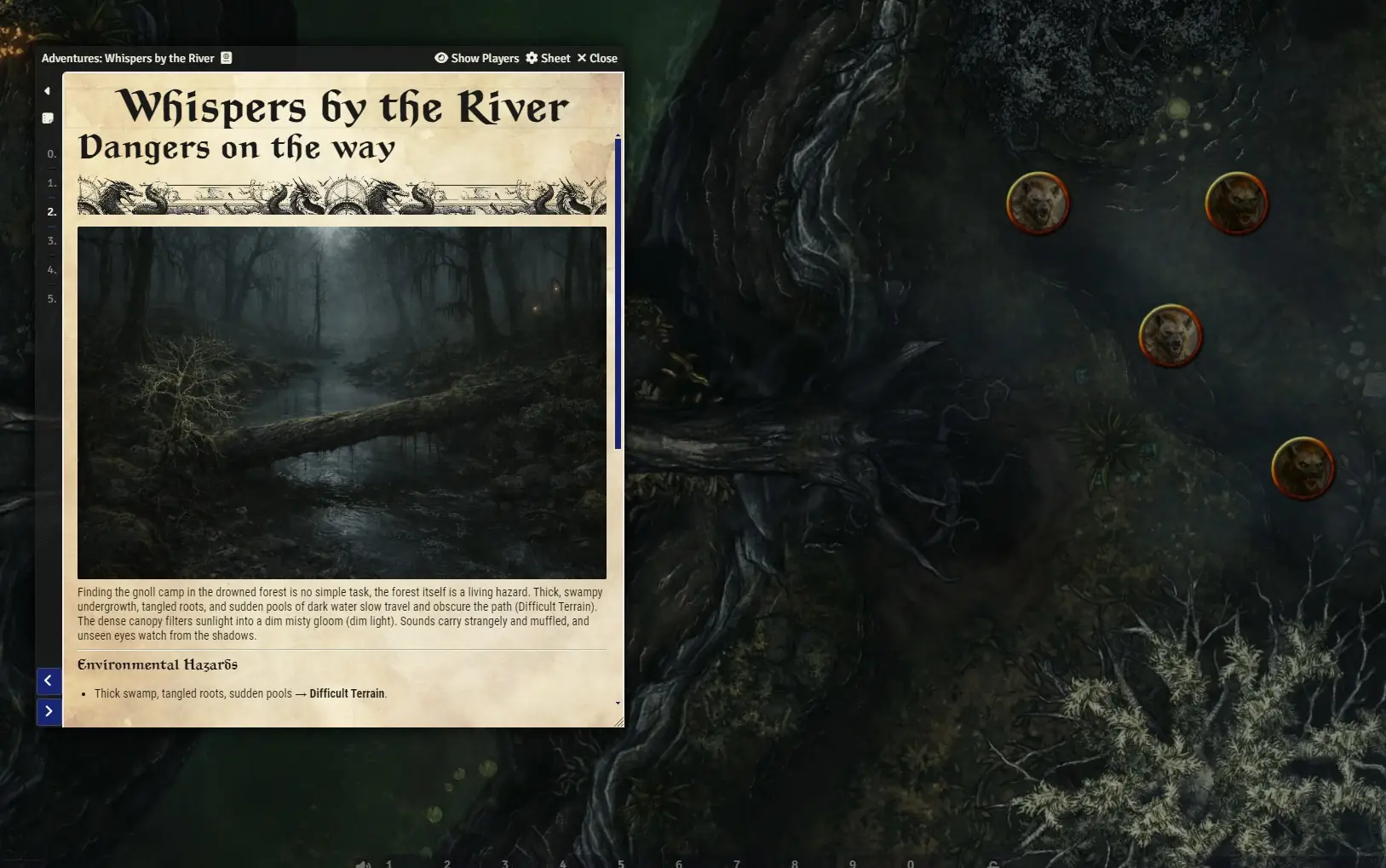
The first release, Whispers by the River, begins with a growing problem along the road to Burle. Gnolls raid travelers from a hidden camp near the Drowned Forest. Merchants vanish. Rumors of undead begin to spread through Saltmarsh.
Over time, the project will continue to expand with:
- New adventures
- Additional locations
- Expanding NPC storylines
- Deeper faction conflicts
Much like Legends of Barovia, the goal is for this setting to grow and evolve over time.
Built in Legend Keeper — Free for the Community
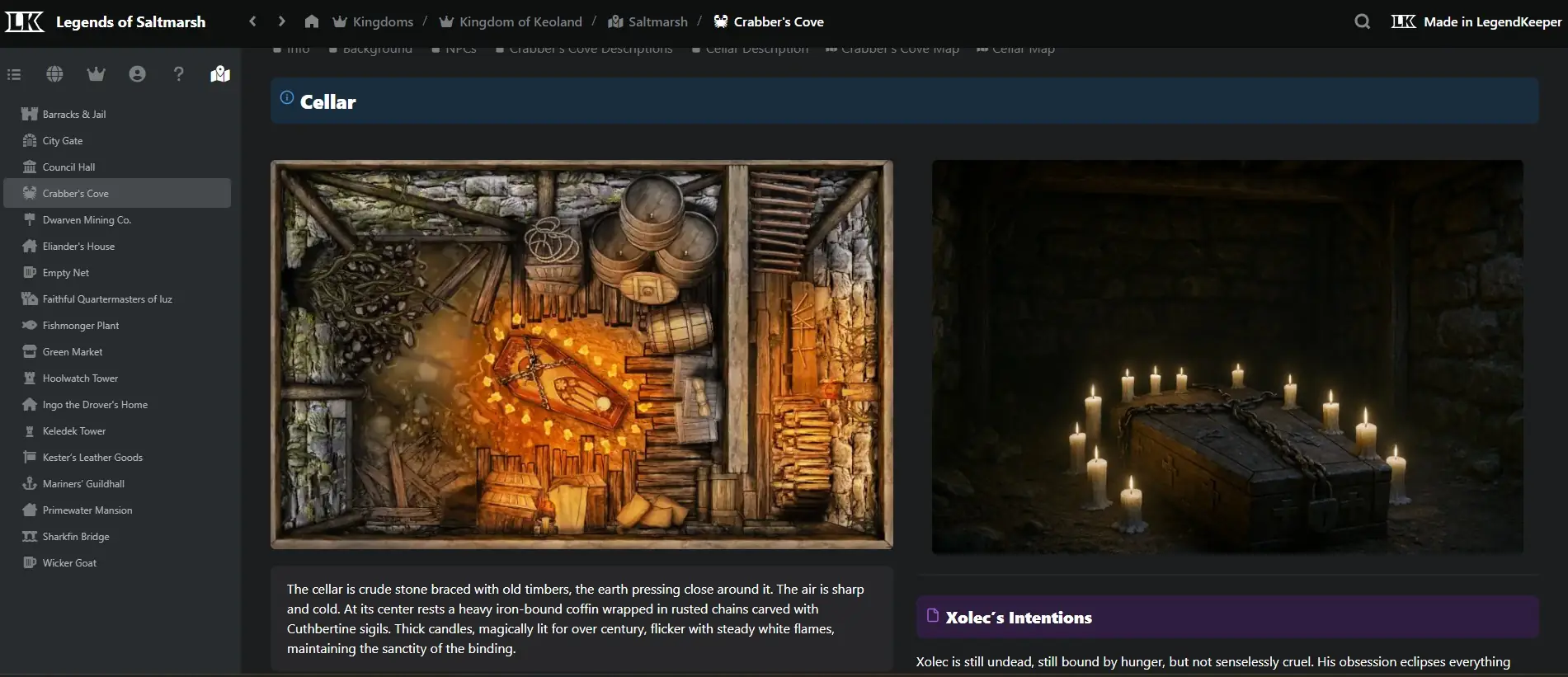
Legends of Saltmarsh is being developed openly in Legend Keeper and is available for free.
Subscribers to the newsletter gain access to the project as it grows. You can explore the setting in real time and watch the town develop month by month.
The core material is meant to remain accessible to the community.
For Supporting Members
For those who want additional tools or wish to support the project, three optional tiers of content are available.
Check out all the downloads for Legends of Saltmarsh.
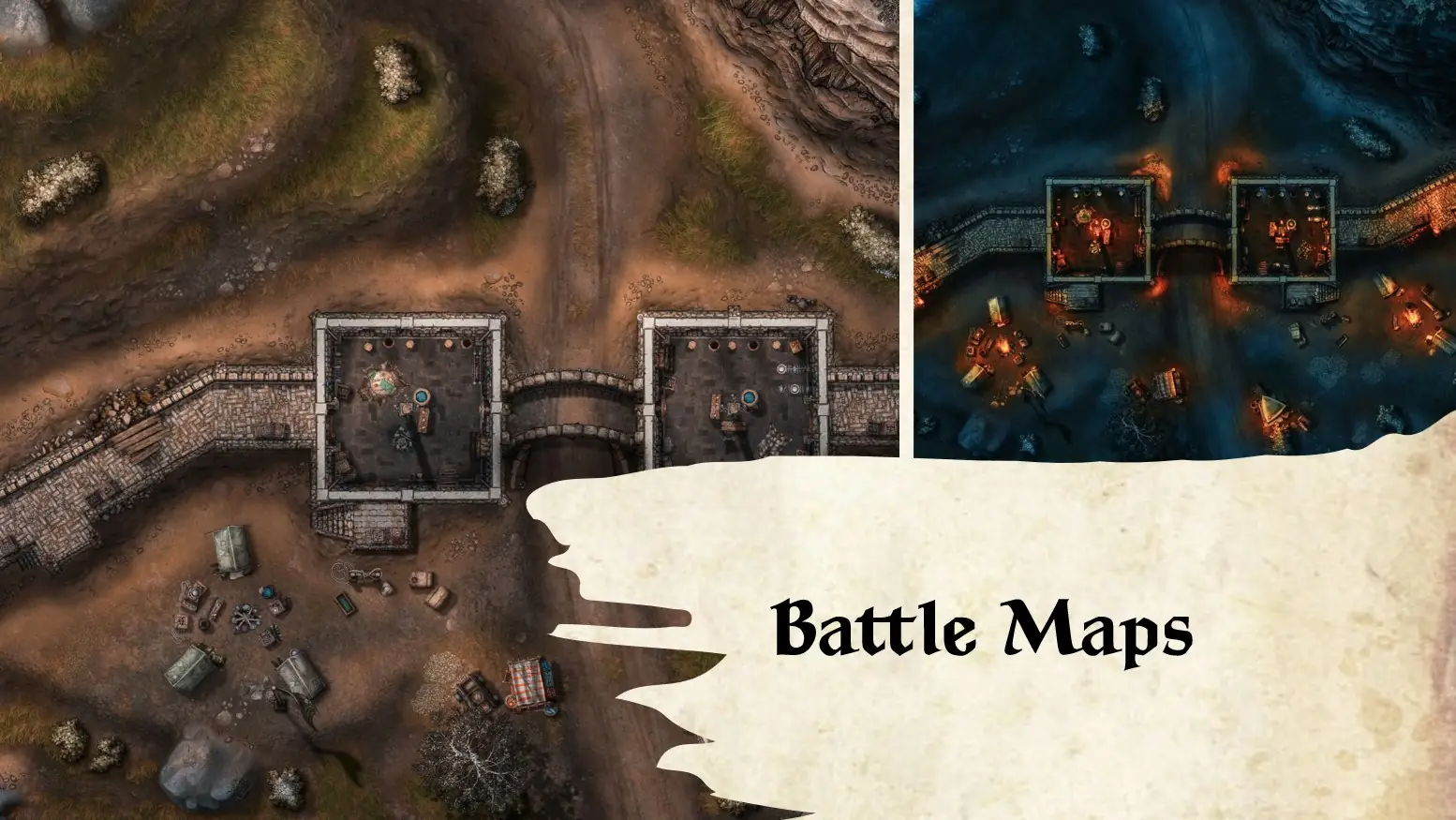
Digital Asset Packs
Ready-to-use table resources including:
- Battle maps
- Theater-of-the-mind scenes
- Tokens
- Ambient sound
- Player handouts
These assets are designed for platforms like Owlbear Rodeo, Roll20, or Discord play.
Foundry VTT Modules
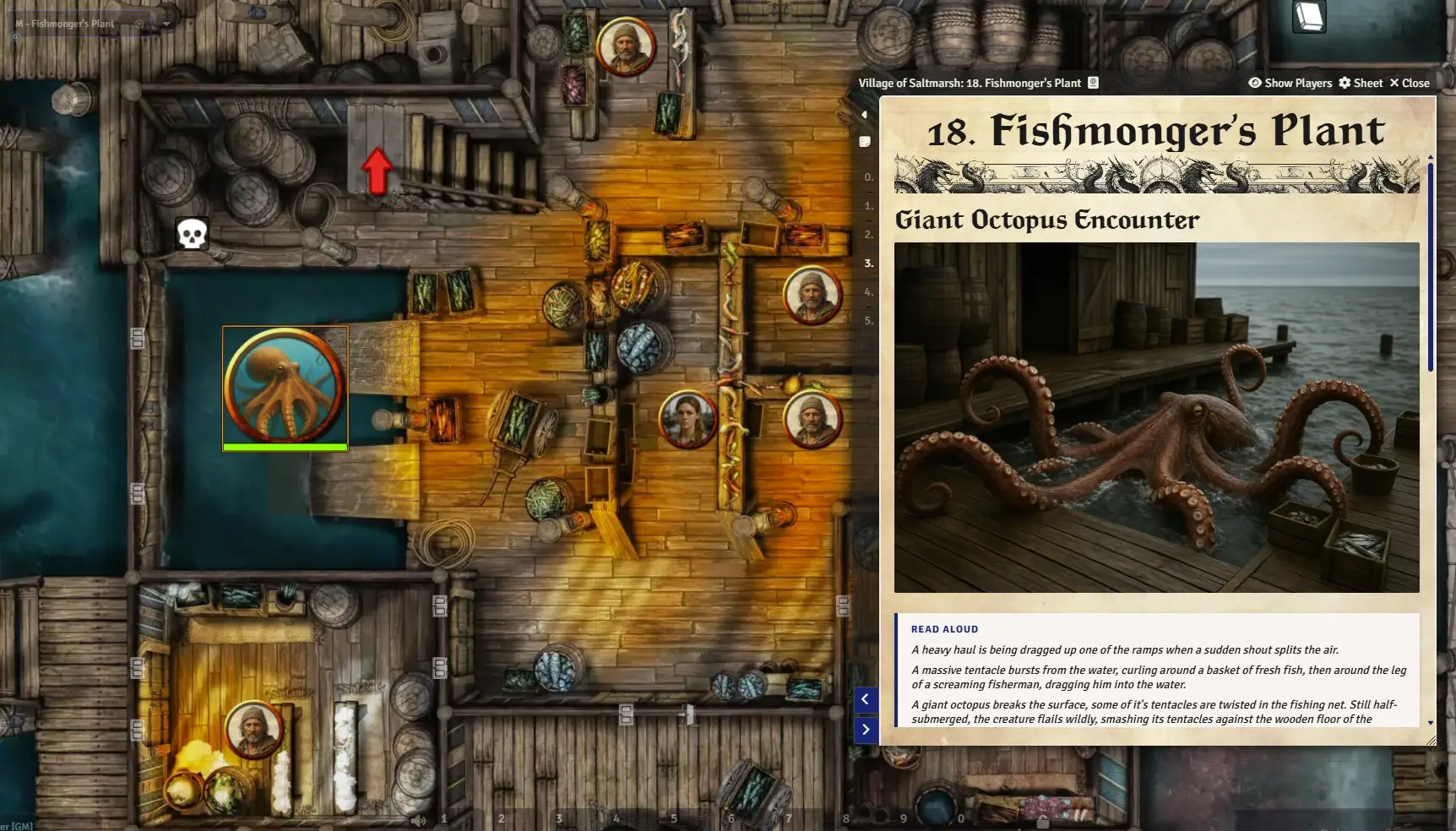
For Foundry users, the project is delivered as a fully integrated module including:
- Actors and stat blocks (5E version)
- Fully prepared maps with walls and lighting
- Sound integration
- Organized journal entries
There is also a system-agnostic version that removes stat blocks so you can run the content in Shadowdark, Pathfinder, Nimble, or any other system.
Legend Keeper, Markdown, and JSON Files
For those who want full control, the entire dataset will eventually be released as:
- Legend Keeper install files
- Markdown files for Obsidian or Notion
- Raw JSON files for custom tools
In short: Everything in the kitchen sink.
The Vision
Legends of Saltmarsh isn’t just a product.
It’s a growing campaign ecosystem rooted in Greyhawk lore, grounded medieval fantasy, and the political tension of a small coastal town.
It is designed to be:
- Easy to run
- Expandable over time
- Flexible across game systems
- Accessible to the community
Saltmarsh is not a sprawling city or a forgotten hamlet.
It sits perfectly in the middle.
Small enough that every NPC matters.
Large enough that every action can change the future.
And that’s why it might just be the perfect village for your next adventure.