
Introduction
For more than four decades, Ravenloft has stood as one of the most iconic and enduring settings in Dungeons & Dragons. Among its many memorable elements, few are as mysterious or as powerful as the tarokka deck.
Derived from tarot cards and steeped in superstition, symbolism, and fate, the tarokka deck has been part of Ravenloft since the very beginning. Madame Eva, one of the setting’s most enduring NPCs, has appeared in every incarnation of Ravenloft since Module I6: Ravenloft in 1983. Her reading at the Tser Pool encampment, now a pivotal moment in Curse of Strahd for 5e, has captivated players and Dungeon Masters alike since its reintroduction in 2016.
Yet despite its long history, much of the lore surrounding the tarokka deck has faded into obscurity. While Curse of Strahd and Van Richten’s Guide to Ravenloft include references to the deck, they lack the depth, context, and practical guidance found in earlier editions. Important ideas, techniques, and interpretations have quietly been left behind.
To help preserve that history and to make the tarokka deck easier to use at the table, I created a FREE Tarokka: A History & Guide. This post provides an overview of the deck’s history and its value as a storytelling tool, while the guide itself goes deeper into mechanics, methods, and practical use.
Uses of the Tarokka Deck
The tarokka deck is not just a prop for Curse of Strahd.
It is an incredibly versatile storytelling tool that can be used in any campaign, and in any role-playing system, well beyond D&D.
The tarokka deck can be used to:
- Read character fortunes
- Reveal hidden truths or past events
- Locate a powerful object
- Introduce or foreshadow an enemy
- Spark a new quest or complication
And that’s only the beginning.
Used creatively, the tarokka deck becomes a narrative tool that invites mystery, player agency, and interpretation at the table. The possibilities are genuinely limitless.
How to Use the Tarokka Deck
There are several established methods for performing a tarokka reading, also known as a “casting,” a term introduced in Forbidden Lore (2e). Both Forbidden Lore (2e) and the Ravenloft Dungeon Master’s Guide (3e) describe four primary techniques for conducting tarokka readings:
- Random
- Changing the Odds
- Multiple Choice
- Stacking the Deck
Curse of Strahd (5e) expands on the Multiple Choice method, but omits the others entirely.
To bring clarity and structure back to the system, I’ve compiled, edited, and unified instructions from all three editions. I also introduce my own Stone-Cold Reading method, along with practical advice and table-ready guidance to help you run compelling readings with confidence.
All of these methods are covered in detail in the FREE Tarokka: A History & Guide.
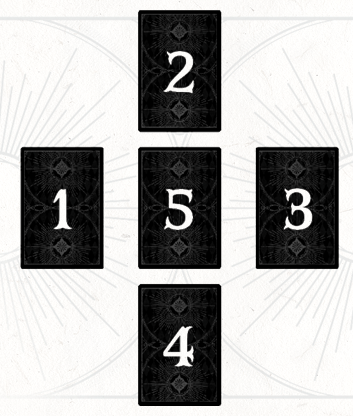
The Reading Methods
Luck of the Draw (Random)
If the DM is quick on their feet, a tarokka reading can be performed entirely at random. Cards are drawn openly, and the results are interpreted on the fly.
This approach is excellent for generating unexpected plot hooks, NPC motivations, and emergent story threads.
Changing the Odds (Special Cards)
To simplify the process, the DM may first remove cards that don’t fit the intended tone or scope of the reading.
Once unsuitable cards are removed, the remaining deck is used for a “random” reading, with the confidence that every draw can be meaningfully incorporated into the narrative. This method strikes a balance between structure and spontaneity.
Multiple Choice (Random Determination)
This method requires advance preparation and works best when the DM knows the party will be visiting a fortune reader.
Rather than focusing on individual card meanings, the DM assigns predetermined answers to each suit; stars, glyphs, swords, coins, and the Fortuna Magna. Before the reading begins, five possible outcomes are already defined, and the cards simply determine which one is revealed.
This approach emphasizes fate and inevitability while still preserving the illusion of chance.
Stacking the Deck (Predetermined)
In this method, the DM predetermines both the layout and the order of the cards.
It offers the greatest level of control and is ideal for DMs comfortable with sleight of hand or for those who want to avoid unexpected outcomes entirely. When used carefully, it can produce powerful, cinematic readings without breaking immersion.
Stone-Cold Reading (Forced Persuasion)
The Stone-Cold Reading is my preferred method.
It requires no preparation, no gimmicks, and no manipulation of the deck. The player shuffles the cards. They examine them. They cut the deck themselves.
To use this technique effectively, the DM should keep three things in mind:
the PC’s backstory, the current campaign or adventure, and the significance of the card positions and patterns.
The DM should know what they want to communicate ahead of time, then use the drawn cards to add flavor, symbolism, and texture to that outcome. For example, if a character left home to join a secret order, any card can be used to enrich that moment, even if the card isn’t directly tied to the past.
The result is a personalized reading crafted in real time, using interpretation, tone, and narrative framing rather than rigid mechanics. It’s flexible, intimate, and especially effective for character-focused moments.
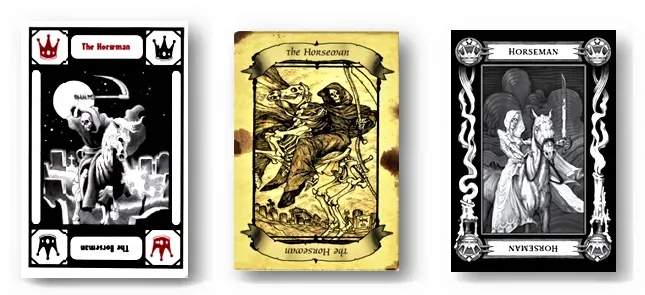
Tarokka Deck Release History
- 1992 – The first tarokka deck appeared in the Forbidden Lore boxed set for 2nd Edition. This version is often referred to as the Red and Black Deck.
- 2003 – A second deck was released for 3rd Edition under the name The Ravenloft Deck. Free digital versions of this deck are available.
- 2016 – The most recent iteration was released alongside Curse of Strahd for 5th Edition. This version is simply called the tarokka deck and is currently available in print. Free digital versions of earlier decks can also be found.
Why This Guide Exists
I wrote this free guide to preserve the history, lore, and often-forgotten techniques of the tarokka deck and to inspire its use in any fantasy role-playing game, not just D&D 5e.
Over the years, important context and practical guidance surrounding the tarokka deck has been lost or fragmented across editions. This guide brings those pieces back together in one place, presenting the deck not just as lore, but as a powerful tool for storytelling at the table.
Inside the Guide You’ll Find
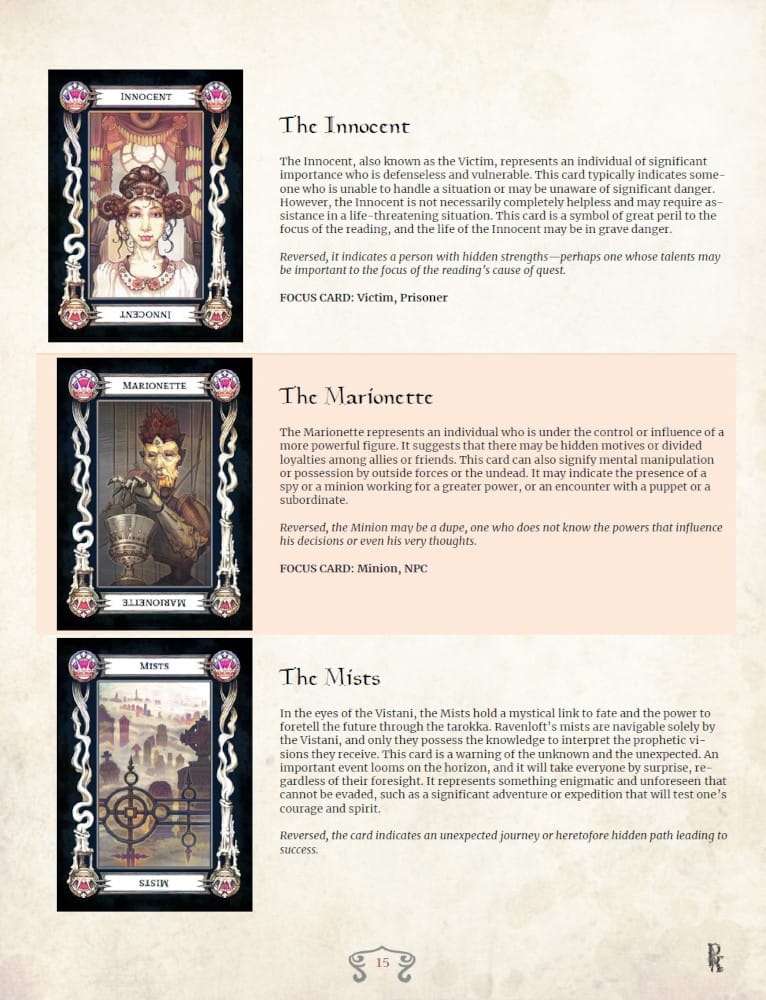
- A complete history and evolution of the tarokka deck
- Guidance on crafting or creating your own tarokka deck
- Clear explanations of the Lesser Deck and the Fortuna Magna
- Suit symbolism, alignment, and the use of focus cards
- All known methods of tarokka readings, unified and clarified
- Step-by-step layouts and position meanings
- Detailed card descriptions for every suit
- Quick-reference tables for use during play
- Optional patterns and layouts for deeper readings
- Free digital cards and references
Whether you want to run a traditional Ravenloft-style reading or adapt the tarokka deck for your own setting, this guide is designed to be practical, flexible, and easy to use at the table.
Free Downloads
If you want to start using the tarokka deck right away, everything you need is available below.
- FREE PDF: Tarokka - A History & Guide
A complete reference with card meanings, reading layouts, and guidance for running tarokka readings at the table. - Free Digital Ravenloft Cards
Digital version of the classic Ravenloft deck. Ideal for VTTs. - Free Digital Color Tarokka Cards
Digital version Full-color tarokka cards. Ideal for VTTs.
For a complete list of all Legends of Barovia Guides click here.