
Designing Purpose Driven Adventures
It has become a cliché: the fantasy TTRPG that starts in a tavern.
The party meets. Someone passes a note. A mysterious stranger offers coin. Or they are simply told, “You are all here. Now go.” From there, they either wander through a sandbox or get nudged into a prewritten campaign.
It works. But I often found myself asking: is there a better way?
Influence
There are many incredible adventures and campaign settings out there. But one campaign stands apart as something truly epic in how it ties the world together through cause: Masks of Nyarlathotep for Call of Cthulhu.
To many, it is considered the greatest campaign ever written. The reason is simple. It feels alive. It ties the world together. It is open, expansive, and far from a straight line. It is built on player agency.
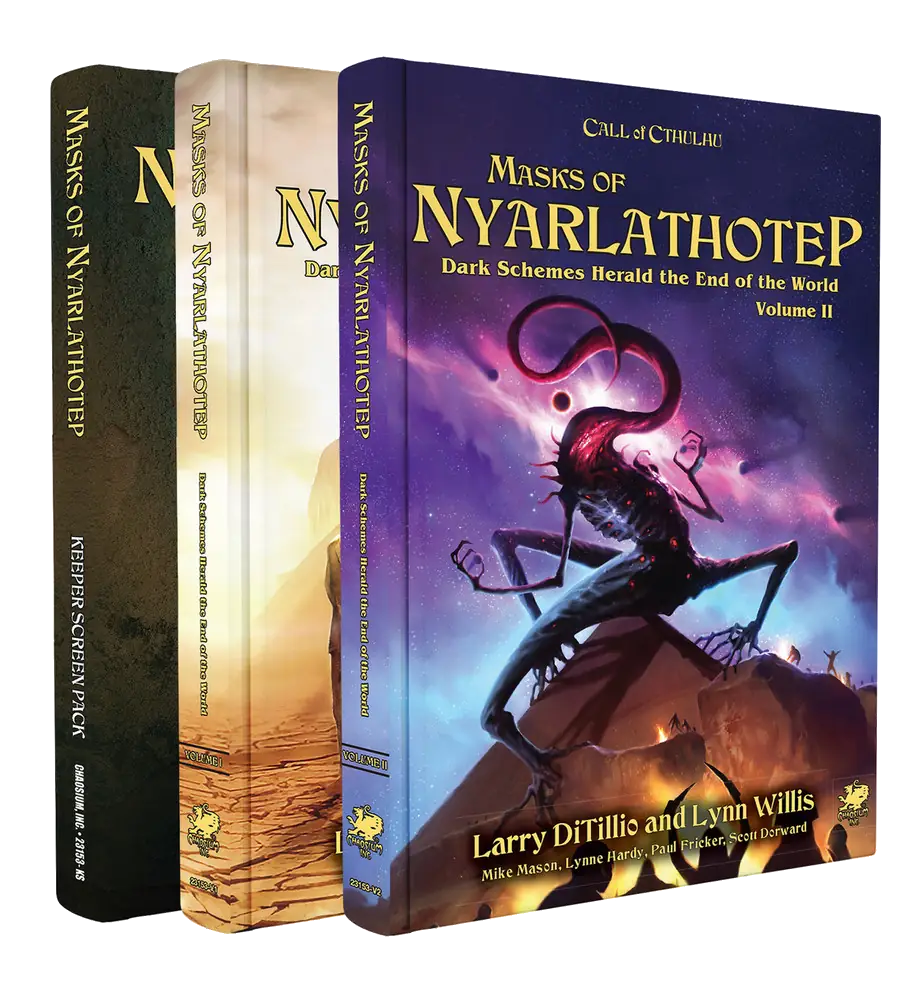
Two elements make it exceptional.
First, the interconnected conspiracy.
Everything connects through cult networks, ancient artifacts, and the influence of Nyarlathotep acting through many identities and faces.
Second, player driven investigation.
It is not linear. Players follow clues, build alliances, lose allies, and uncover deeper layers of truth. Different tables often experience the campaign in completely different ways.
It was first written in the 1980s and had a profound influence on me. While Ravenloft remains one of my favorite settings from that era, Masks of Nyarlathotep always felt the most real. The most connected. The most alive.
It has been updated several times, most recently for Call of Cthulhu 7th Edition in 2018. For many who know it well, it still stands as the greatest campaign adventure ever written.
When I was expanding Curse of Strahd into Legends of Barovia, I realized this was one of the weakest points in many fantasy games.
In Curse of Strahd, the player hooks are vague. The characters are pulled into the mist and deposited into Barovia, but they have no personal reason to be there beyond escape.
That becomes their only motivation.
Escape the mists.
Kill Strahd.
Break the curse.
It is simple.
It works.
But it lacks meaning.
Masks of Nyarlathotep pushed me to think about a different approach.
Giving Players a Reason to Care
In Legends of Barovia, I began writing alternative hooks to give characters personal motivation.
One character received a letter from their estranged grandmother, a Vistani woman, pleading for help from within the land of shadow.
Another had been afflicted by a werewolf bite and sought a hidden clan who could tame the beast within.
The most popular was the Epic Fey Quest. A lost myth, buried in a forbidden book, hinting at an ancient fey presence and the possibility of restoring light to Barovia.
These quests worked because they gave the characters a cause. They created personal stakes. Escape was no longer the only goal.
Open Ended Quests and Saltmarsh
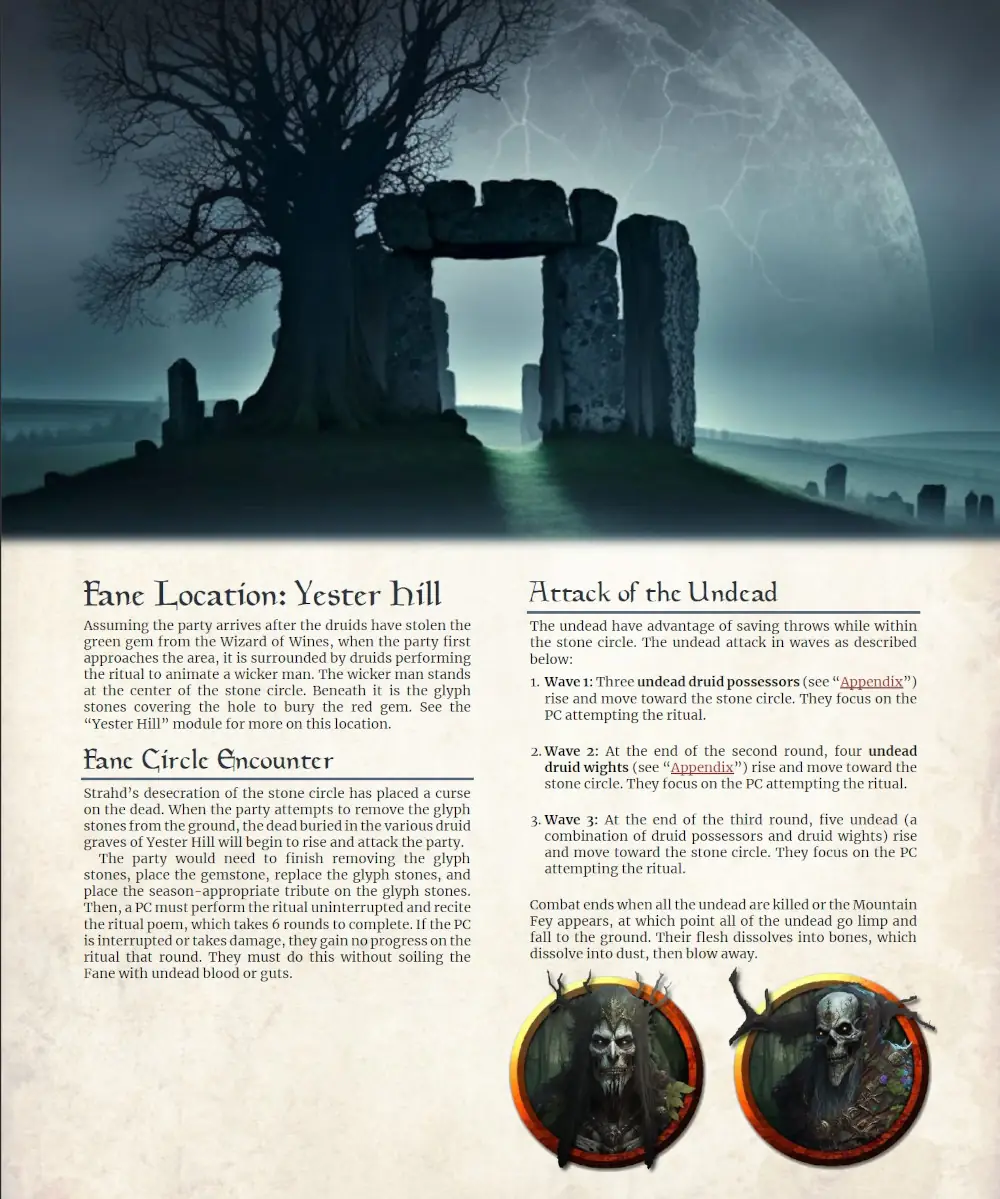
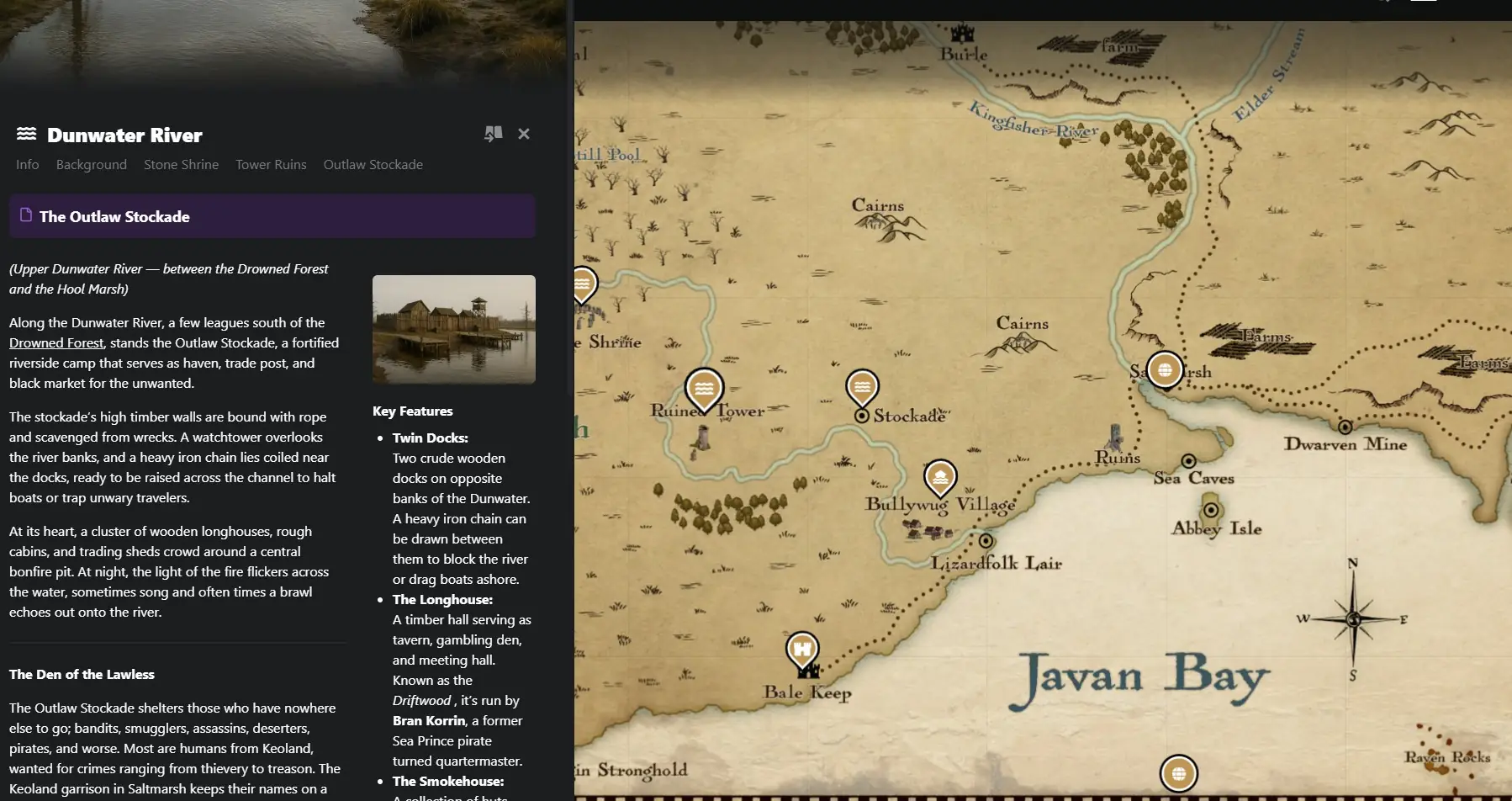
In Legends of Saltmarsh, this idea evolved into the Open Ended Quest. A situation, not a task.
Each one tied together an NPC, a motive, and a location. There was no predefined reward and no clear win condition. The quest was not about loot or experience. It was about resolving a dilemma that entangled the characters, often against their will.
Sometimes the reward was gold.
More often, it was closure.
Or at least the illusion of it.
Iron & Myth: Shared Beginnings, Shared Consequences
The experience of creating Legends of Barovia and Legends of Saltmarsh was invaluable to my growth as an adventure writer. It made clear just how important character motivation is, and how much stronger player investment becomes when characters have a real reason to be involved in what is happening.
When I began designing Iron & Myth, I knew I wanted a stronger foundation for character motivation. Not a tavern. Not a bounty board. But a shared experience. Something the players could not simply walk away from.
The design philosophy behind Masks of Nyarlathotep has always stayed with me. The way it weaves everything together. Threads that lead to other places. Other NPCs. Other truths. Some of those Threads grow into something larger. Something more dangerous. They become Knots.
That is where the Writ in Ash was born. Influenced heavily by Masks of Nyarlathotep, and in part by Warhammer The Old World, which explores interesting approaches to introducing adventures through shared events and larger world consequences.
Writ in Ash: A Shared Burden
Think of a Writ in Ash as an adventure seed, but it is far more than that. It creates a shared burden. Shared risk. Shared mystery. Shared pressure.
Rather than beginning in a tavern, the story begins in motion. The action starts immediately. The characters all witness or become part of the same formative event. Maybe they:
- Stumble upon a cult ritual meant to raise the dead
- Discover a relic a noble house would kill to possess
- Are entrusted with a secret that could destabilize an entire region
Whatever the spark, it binds them together.
The Writ in Ash forces action. It demands a response. Whether they run, fight, or try to deny it, the Writ follows them.
Walking away is not an option.
The Writ rises.
It needs resolution.
Example: The Bone Tongue Rite
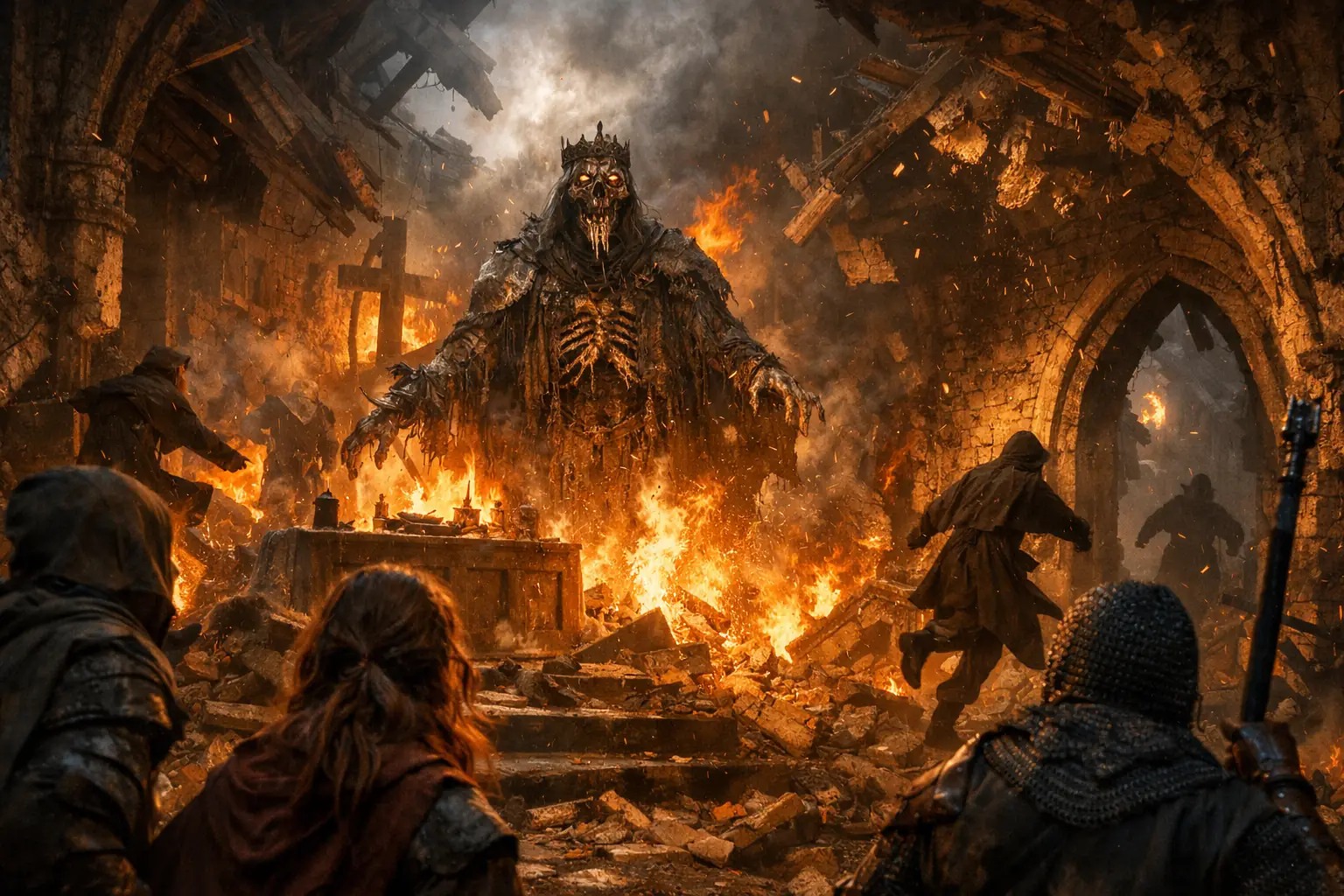
The characters are fleeing a burning village when they hear unnatural chanting coming from a half collapsed church.
Inside, hooded figures perform the Bone Tongue Rite, an ancient heretical ritual meant to resurrect a long dead warlord.
Before the party can intervene, the burning church begins to fail. The walls collapse inward. The cultists are unable to complete the final binding of the corpse. Yet something still answers the ritual.
In the fire and falling stone, the corpse rises.
The cultists scatter into the night.
When the smoke clears, the player characters are seen standing beside the burning remains of the church. To anyone watching, it looks like they were part of it.
Now everyone believes they are involved.
The Church wants them silenced.
The nobles want the secret.
The cult wants to finish what was started.
And something… has awakened.
From that moment forward, they carry the Writ.
It cannot be escaped.
It can only be resolved.
Open World
Iron & Myth is truly an open world sandbox. The Writ in Ash provides the instigation, the hook, the pressure, and the mystery.
It plants a seed that can grow into anything. Dungeons. Crypts. Haunted forests. Dark cities. Political intrigue.
Most importantly, it provides reason. A reason for characters to care. To solve. To explore.
Referee Tools: Seeds and Omens
To help Referees guide a Writ in Ash, Iron & Myth offers two narrative tools.
Seeds
Clues and fragments that hint toward resolution:
- A letter with forgotten names
- A bloodstained map
- A cryptic song sung by madmen
Seeds help players understand the situation. They do not solve it, but they show the direction forward.
Omens
Signs that the situation is worsening:
- A second corpse found with the same symbol
- A full moon that stirs something inside a party member
- A noble declaring them enemies of the state
Omens escalate risk and create urgency. They ensure the players cannot ignore what is unfolding.
Seeds provide information.
Omens create pressure.
Together, they keep the story moving.
Threads and Knots: Expanding the World
While working on Legends of Barovia and Legends of Saltmarsh, I learned not to isolate everything. Locations, NPCs, and events should connect. What happens in one place should pull on something somewhere else.
Just like real life, events weave together.
One NPC might be a shopkeeper. That shopkeeper had a run in with a thief. That thief stole something for a noble. That noble was connected to something much larger.
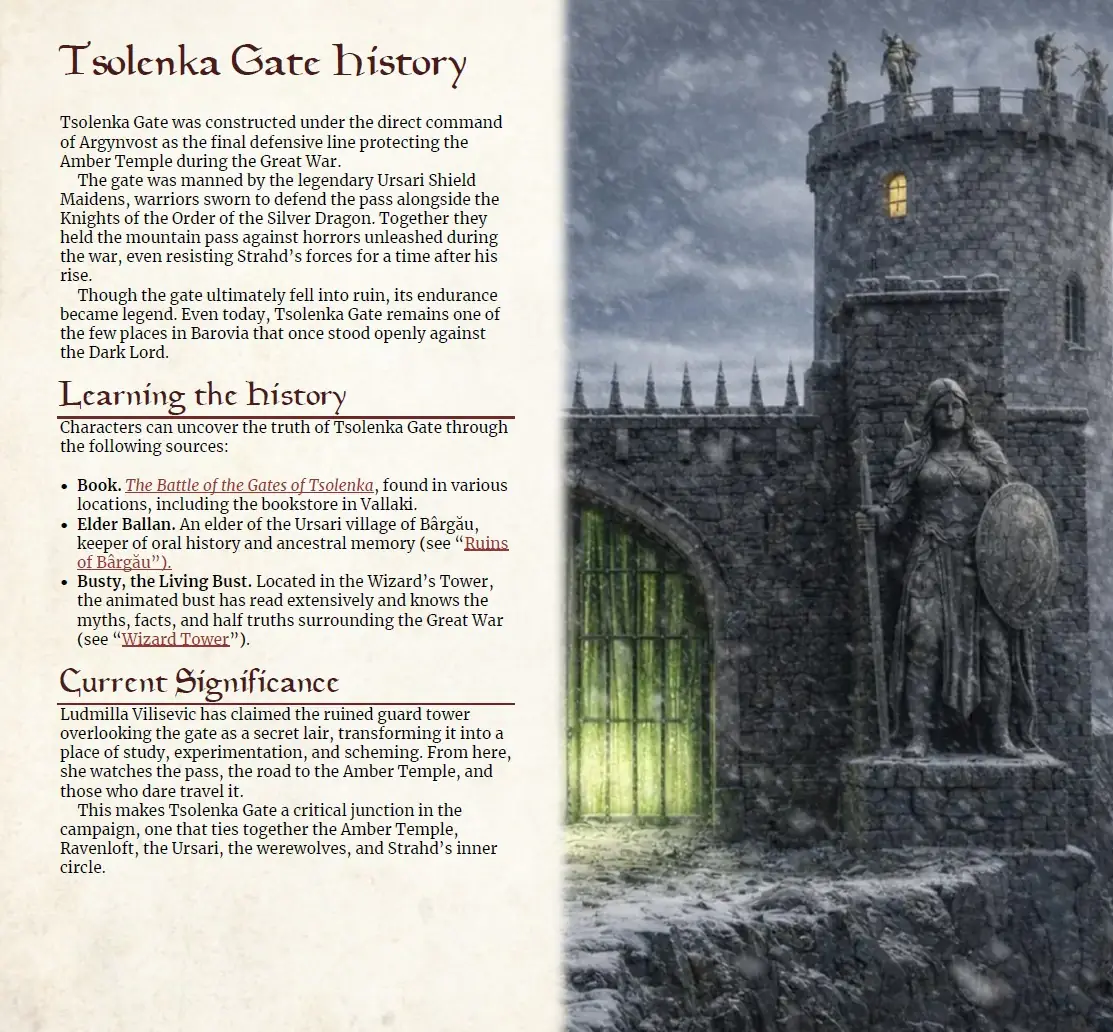
Working on Vallaki in Legends of Barovia was my first real experience tying threads together inside a city while also pulling connections outward. The leathershop owner's missing daughter connects to the Wolf Den. The Wolf Den connects to the Tsolenka Gate. That connects back to Ravenloft.
Threads
Threads are loose connections that tie places, people, and events together. They may not seem important at first, but they hint at deeper truths and future adventures.
Some Threads support the current Writ in Ash, giving context, clues, or complications. Others simply exist in the world, waiting to be discovered, waiting to become the foundation of the next Writ in Ash.
Not every Thread must resolve now. Some are meant to linger. Some are meant to pull later.
Knots
When multiple Threads converge, a Knot is formed.
Hidden agendas align. NPCs know each other. Symbols repeat across regions. Events that seemed separate reveal a shared cause.
Vallaki is one such Knot.
Saltmarsh is another.
Knots are natural places for the next Writ in Ash to emerge once the current one resolves.
Only one Writ should be active at a time. But as players explore, they pull on Threads that may lead toward future Writs in Ash. What looks like an unresolved mystery may simply be the beginning of another Writ waiting to surface.
If players pull too hard, the Knot tightens.
And when it tightens, the next Writ is born.
Someone begins hunting them.
They witness something they were never meant to see.
They uncover something better left buried.
Whatever it is, it follows them.
And it does not end until it is resolved.
Conclusion: Why It Matters
A world with cause is a world that matters.
Characters should enter the game already bound to it through blood, fate, or consequence. Not starting in a tavern, but starting in motion. In danger. In a moment that forces them to act.
That is what a Writ in Ash delivers.
It is not a prompt.
It is a burden.
It demands a response.
And whatever that response is, it will shape the world.
I am excited to build future adventures using this structure in my upcoming RPG, Iron & Myth. I see myself first as an adventure and setting creator, and second as a TTRPG designer. My hope is that future Iron & Myth adventures can reach that same level of interconnection and living world design that made Masks of Nyarlathotep so legendary.
If you are interested in Legends of Barovia, all PDF guides are available for free download.
Legends of Saltmarsh is currently in development and is available online for free.
Subscribe for notices, updates, and exclusive subscriber insights as Iron & Myth continues to grow.
Subscribing is free.